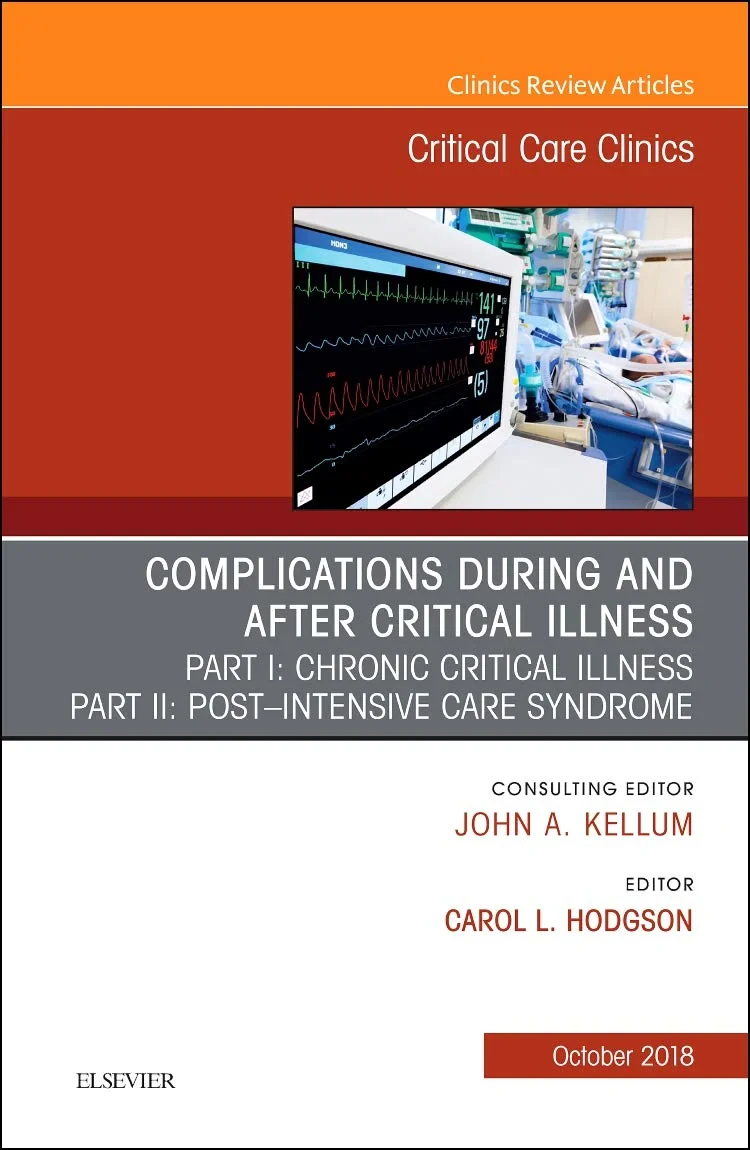
This issue of Critical Care Clinics focuses on Post-intensive Care Syndrome & Chronic Critical Illness, with topics including: Chronic Critical Illness; Chronic Critical Illness and Predicting Outcomes; Persistent Critical Illness; Rehospitalization and Preventing CCI; Measuring Post-Intensive Care Syndrome; Post-Intensive Care Syndrome and teh Role of the ICU Clinician; Frailty and the Association between Long-Term Recovery After ICU; The Role of the Muscles in Post-Intensive Care Syndrome; Intensive Care Nutrition and Post-Intensive Care Recovery; Early mobilization in the ICU to Improve Long Term Recovery; The Use of Sedation in the ICU and Long-Term Outcomes; Cognitive Function after Critical Illness; Anxiety and Depression after ICU; and Family and Support Networks after ICU.
· Section 1: Chronic Critical Illness
· Patient and Population-Level Approaches to Persistent Critical Illness and Prolonged Intensive Care Unit Stays
· Key points
· The epidemiology of long stays in the intensive care unit
· Patient-level differential diagnosis
· Population impact
· Implications of a persistent critical illness framework
· Preventing Chronic Critical Illness and Rehospitalization: A Focus on Sepsis
· Key points
· Introduction
· Medical setbacks and hospital readmission
· Prevention, mitigation, and rehabilitation strategies
· Summary
· Section 2: Post-Intensive Care Syndrome
· Measuring Outcomes After Critical Illness
· Key points
· Introduction
· Outcome domains after critical illness
· Functional status
· Linking diseases with impairments and disabilities
· Summary
· Frailty and the Association Between Long-Term Recovery After Intensive Care Unit Admission
· Key points
· Introduction to frailty
· Pathophysiology of frailty
· Measurement of frailty
· Frailty and critical illness
· Outcomes of frailty in critical illness
· Strategies and interventions
· Addressing knowledge gaps with future work
· Summary
· The Pathophysiology of Neuromuscular Dysfunction in Critical Illness
· Key points
· Introduction
· The condition
· Risk factors
· Mechanisms
· Time frame
· Summary
· Early Mobilization in the Intensive Care Unit to Improve Long-Term Recovery
· Key points
· Introduction
· Summary
· Intensive Care Nutrition and Post–Intensive Care Recovery
· Key points
· Introduction
· To feed or not to feed?
· Is early supplementation of insufficient enteral nutrition with parenteral nutrition beneficial?
· Is early enteral nutrition better than early parenteral nutrition?
· Is early full enteral nutrition beneficial?
· Do high doses of amino acids provide benefit?
· Is indirect calorimetry–based feeding superior to calculation-based feeding?
· Is there a role of adding immunonutrients?
· Mechanisms explaining the absence of a benefit of early full feeding
· Nutrition during recovery and after intensive care unit stay
· Summary
· Sedation, Delirium, and Cognitive Function After Critical Illness
· Key points
· Introduction
· Sedation during critical illness
· Delirium during critical illness
· Cognition after critical illness
· Summary
· Psychiatric Morbidity After Critical Illness
· Key points
· What is meant by psychiatric morbidity?
· How is psychiatric morbidity measured?
· Why is psychiatric morbidity relevant to critical illness?
· How often do critical illness survivors develop psychiatric morbidity?
· Which patient factors are associated with psychiatric morbidity after critical illness?
· What intensive care unit and early postintensive care unit factors are associated with later psychiatric morbidity?
· Which interventions are effective in decreasing postcritical illness psychiatric morbidity?
· What if patients have substantial psychiatric morbidity at follow-up visits?
· Summary
· Family and Support Networks Following Critical Illness
· Key points
· Introduction
· Psychosocial outcomes of informal caregivers across the care arc
· Outcome measurement
· Interventional research to improve caregiver psychosocial outcomes
· Innovative approaches to rapidly build social support networks









Recenzii
Nicio recenzie găsită.