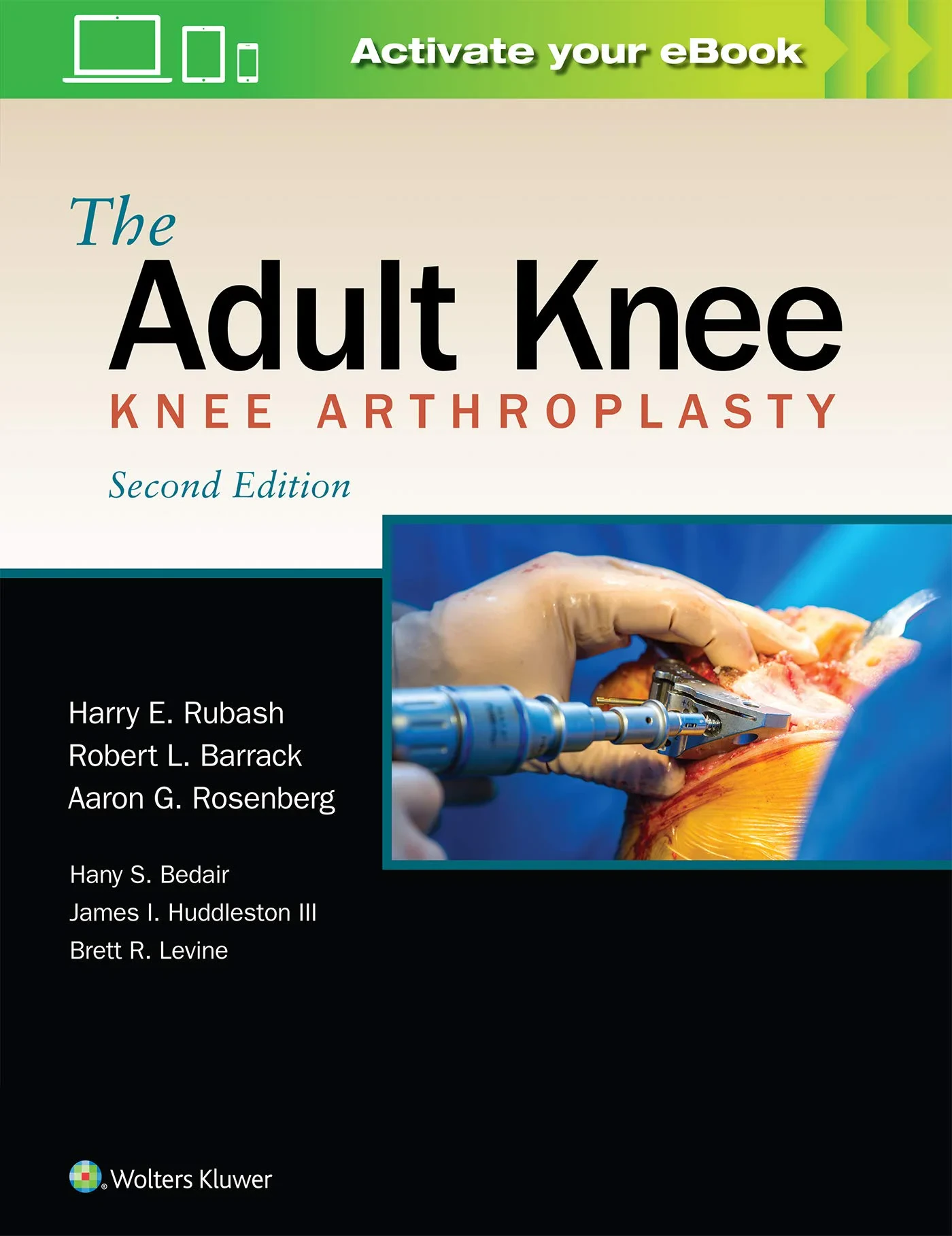
As knee replacement surgeries continue to grow in number worldwide, the need for an authoritative and comprehensive reference in this key area is a must for today’s orthopaedic surgeon. The Adult Knee: Knee Arthroplasty, Second Edition, brings together the knowledge and expertise of internationally recognized experts in the field in one convenient volume.
- Covers knee biomechanics relevant to knee arthroplasty, alternatives to knee arthroplasty to alleviate arthritis, and primary total knee arthroplasty, including perioperative issues.
- Discusses complications including stiff knee, periprosthetic fractures, and instability, revision total knee arthroplasty, and management of infections in total knee replacement.
Enrich Your Ebook Reading Experience
- Read directly on your preferred device(s), such as computer, tablet, or smartphone.
- Easily convert to audiobook, powering your content with natural language text-to-speech.
Table of Contents:
1. Cover
2. Title Page
3. Copyright
4. Dedication
5. Contributors
6. Preface
7. Contents
8. SECTION 1 Historical Perspectives
9. 1 Total Knee Arthroplasty: Milestones
10. INTERPOSITION ARTHROPLASTY
11. HEMIARTHROPLASTY
12. HINGED KNEE PROSTHESES
13. RESURFACING KNEE PROSTHESES
14. ANATOMIC APPROACH
15. FUNCTIONAL APPROACH
16. CEMENTLESS FIXATION
17. MOBILE BEARING
18. ALTERNATIVE MATERIALS IN TKA
19. ADVANCES IN PERIOPERATIVE CARE
20. FUTURE OUTLOOK
21. 2 Surgical Anatomy of the Knee
22. INTRODUCTION
23. EMBRYOLOGY
24. BONES OF THE KNEE
25. Femur
26. Tibia
27. Fibula
28. Patella
29. KNEE JOINT STRUCTURES
30. Menisci
31. Cruciate Ligaments
32. Synovial Membrane and Cavity
33. Knee Joint Bursae
34. Capsule
35. THREE LAYERS OF THE MEDIAL AND LATERAL KNEE
36. Layers of the Medial Knee
37. Layers of the Lateral Knee
38. KNEE JOINT MUSCLES AND STABILITY
39. Knee Flexors
40. Knee Extensors
41. Knee Joint Stabilization
42. KNEE MOTION
43. ARTERIES
44. Geniculate Vessels and Knee Anastomoses
45. VEINS
46. NERVES
47. Muscle and Knee Joint Innervation
48. Cutaneous Innervation
49. CONCLUSION
50. 3 Anesthesia for Total Knee Replacement
51. INTRODUCTION
52. PREOPERATIVE PHASE
53. MULTIMODAL AGENTS
54. Acetaminophen
55. Nonsteroidal Anti-inflammatory Drugs
56. Gabapentinoids
57. INTRAOPERATIVE PHASE
58. Anesthesia Techniques
59. Dexamethasone
60. Tranexamic Acid
61. POSTOPERATIVE ANALGESIA
62. Local Infiltration Analgesia
63. Femoral Nerve Block
64. Adductor Canal Nerve Block
65. Interspace Between the Popliteal Artery and Posterior Capsule of the Knee Block
66. Postoperative Multimodal Analgesia
67. CONCLUSION
68. SECTION 2 Basic Science
69. 4 Meniscus, Tendons, and Ligaments: Pathophysiology
70. MEDIAL MENISCUS
71. LATERAL MENISCUS
72. MENISCUS STRUCTURE
73. Vascular Supply
74. Neurology
75. Biomechanical Properties
76. INJURIES
77. DEGENERATIVE TEAR
78. ACUTE TEAR
79. RELATION OF TEAR LOCATION TO HEALING
80. TENDON
81. Normal Structure and Function
82. Tendon Junctional Anatomy
83. BIOMECHANICS
84. INJURIES
85. Patterns of Injury
86. DEGENERATION
87. TENDON HEALING AND REPAIR
88. LIGAMENT
89. Normal Structure and Function
90. Biomechanics
91. INJURIES
92. Degenerative Tears
93. Intra- Versus Extra-articular Ligament Injury
94. 5 Knee Arthritis: Pathology and Progression
95. INTRODUCTION
96. OSTEOARTHRITIS
97. Epidemiology
98. Symptoms
99. Physical Exam and Diagnosis
100. Imaging
101. Pathophysiology and Progression
102. RHEUMATOID ARTHRITIS
103. Epidemiology
104. Symptoms
105. Physical Exam and Diagnosis
106. Imaging
107. Pathophysiology and Progression
108. JUVENILE IDIOPATHIC ARTHRITIS
109. SERONEGATIVE SPONDYLOARTHROPATHIES
110. OTHER INFLAMMATORY ARTHROPATHIES
111. CONCLUSION
112. 6 Lower Extremity Alignment
113. ANATOMY AND BIOMECHANICS OF THE KNEE
114. KNEE MOTION
115. LOWER EXTREMITY AXES
116. KNEE ALIGNMENT
117. ASSESSING ALIGNMENT
118. ANGULAR COMPONENTS OF CORONAL ALIGNMENT
119. ANGULAR COMPONENTS OF SAGITTAL ALIGNMENT
120. OSTEOTOMIES AND COMPONENT PLACEMENT
121. Alignment Goals
122. Tibial Osteotomy
123. Distal Femur Osteotomy
124. Anterior and Posterior Femoral Condylar Cuts
125. ALIGNMENT STRATEGIES IN TKA
126. CONCLUSION
127. 7 Knee Kinematics Following Total Knee Arthroplasty
128. OVERVIEW OF KNEE KINEMATICS
129. KINEMATIC ANALYSIS TECHNIQUES
130. FLUOROSCOPIC ANALYSIS METHODS
131. KNEE KINEMATICS
132. Deep Knee Bend—Range of Motion
133. Deep Knee Bend—Condylar Translation
134. Deep Knee Bend—Axial Rotation
135. Gait
136. Chair Rise
137. Ramp Activities
138. HIGHLY VARIABLE KNEE KINEMATICS
139. EFFECTS OF CONDYLAR TRANSLATION
140. AXIAL ROTATION OF TKA AND NORMAL KNEES
141. REDUCED RANGE OF MOTION AFTER TKA
142. KNEE KINEMATICS AND PATIENT-SPECIFIC TKA
143. 8 Kinematics of the Normal Knee: In Vivo Investigation Using Advanced Imaging Technique
144. INTRODUCTION
145. IMAGING TECHNIQUE FOR ACCURATE MEASUREMENTS OF KNEE MOTION
146. Tibiofemoral Kinematics and Relevant Coordinate Systems
147. Dual Fluoroscopic Image System
148. KNEE KINEMATICS DURING FUNCTIONAL ACTIVITIES
149. Treadmill Gait
150. Stair Step-Up
151. Kinematics of the Knee During Weight-Bearing Deep Flexion
152. SUMMARY
153. 9 Knee Biomechanics and Implant Design
154. LESSONS FROM THE NATURAL KNEE JOINT
155. Functional Considerations
156. Structural Considerations
157. KNEE REPLACEMENT DESIGN
158. Design of Articular Surfaces
159. Design of Fixation
160. 10 Biomechanical and Clinical Aspects of the Stable and Unstable Total Knee Arthroplasty
161. INTRODUCTION
162. FLEXION INSTABILITY
163. Clinical Presentation
164. Biomechanics of the Native Knee and Stable TKA
165. EXTENSION INSTABILITY
166. Clinical Presentation
167. Biomechanics of the Native Knee and Stable TKA
168. GENU RECURVATUM
169. MID-FLEXION INSTABILITY
170. Clinical Presentation
171. Biomechanics of the Native Knee and Stable TKA
172. SUMMARY
173. 11 Metals
174. METALLIC BOND
175. ALLOY MICROSTRUCTURE
176. CORROSION OF ORTHOPEDIC METAL ALLOYS
177. STAINLESS STEEL ALLOYS
178. Alternative Stainless Steels
179. COBALT–CHROMIUM ALLOYS
180. TITANIUM ALLOYS
181. Other Titanium Alloys
182. OTHER ALLOYS AND SURFACE COATINGS
183. CLINICAL CONCERNS REGARDING METAL IMPLANT DEGRADATION
184. Metal Ion Release
185. Metal Particle Distribution
186. Metal Hypersensitivity Responses
187. Metal-Induced Carcinogenesis
188. STATUS OF METALS IN TKA
189. CONCLUSION
190. 12 Polyethylene in Total Knee Arthroplasty
191. MEDICAL GRADE POLYETHYLENE
192. ARTICULAR SURFACE GEOMETRY
193. METAL BACKING
194. MOTION PATTERN
195. WEAR PARTICLES
196. STERILIZATION METHODS
197. CROSS-LINKING METHODS
198. CONCLUSION
199. ACKNOWLEDGMENTS
200. 13 Damage of Implant Surfaces in Total Knee Arthroplasty
201. INTRODUCTION
202. TIBIAL INSERTS
203. PATELLAR COMPONENTS
204. ULTRAHIGH-MOLECULAR-WEIGHT POLYETHYLENE
205. DAMAGE ON ARTICULATING AND NONARTICULATING SURFACES
206. WEAR MECHANISMS
207. WEAR APPEARANCE AND VOLUMETRIC MATERIAL LOSS
208. OSTEOLYSIS IN TOTAL KNEE REPLACEMENTS
209. FACTORS AFFECTING DAMAGE AND SOLUTIONS TO MINIMIZE WEAR
210. Kinematics and Design
211. Oxidation
212. Mechanical Stress: Conformity and Polyethylene Thickness
213. Modularity and Backside Wear
214. Clinical Variables
215. TECHNOLOGIES TO REDUCE BEARING SURFACE DAMAGE
216. Highly Cross-Linked UHMWPEs and Thermal Treatment
217. Antioxidant Stabilization of Cross-Linked UHMWPEs
218. Surface Grafting of UHMWPE Using 2-Methacryloxyethyl Phosphorylcholine
219. Ceramic and Ceramicized Femoral Components
220. Other Technologies
221. CONCLUSIONS AND FUTURE OUTLOOK
222. 14 Implant Fixation
223. INTRODUCTION
224. CEMENTED FIXATION
225. Basic Science of Polymethylmethacrylate
226. CEMENTLESS FIXATION
227. Biology of Cementless Fixation
228. STANDARD CONCEPTS IN ACHIEVING OSSEOINTEGRATION
229. IMPLANT CONSIDERATIONS: LEARNING FROM OUR MISTAKES
230. REVISION ARTHROPLASTY: ACHIEVING OSSEOINTEGRATION IN SETTING OF BONE LOSS
231. CONCLUSION
232. ACKNOWLEDGMENTS
233. SECTION 3 Clinical Science
234. 15 Examination of the Knee Before and After Total Knee Replacement
235. INTRODUCTION
236. EXAMINATION OF THE KNEE BEFORE KNEE REPLACEMENT
237. Inspection and Observation
238. EXAMINATION OF THE KNEE AFTER KNEE REPLACEMENT
239. Introduction
240. CONCLUSION
241. 16 Imaging of the Native and Prosthetic Knee
242. INTRODUCTION
243. CONVENTIONAL RADIOGRAPHS
244. Standard Views
245. Additional Views
246. COMPUTED TOMOGRAPHY
247. NUCLEAR SCINTIGRAPHY
248. ULTRASOUND
249. Basic Principles
250. Diagnostic Imaging
251. Ultrasound-Guided Intervention
252. BASIC PRINCIPLES OF MAGNETIC RESONANCE IMAGING
253. MENISCI
254. Normal Meniscal Anatomy and Imaging
255. Meniscal Pathology
256. LIGAMENTS
257. Anterior Cruciate Ligament
258. Posterior Cruciate Ligament
259. Medial Collateral Ligament
260. Fibular Collateral Ligament and Posterolateral Corner
261. Knee Dislocation
262. Extensor Mechanism
263. ARTICULAR CARTILAGE
264. Peripheral Nerves
265. POSTOPERATIVE MRI
266. Postoperative Meniscus
267. Ligament Reconstruction
268. Repair of the Articular Surfaces
269. KNEE ARTHROPLASTY
270. CONCLUSION
271. 17 Knee Rating Scales for Clinical Outcome
272. KNEE RATING SCALES FOR CLINICAL OUTCOME
273. Reliability, Validity, and Responsiveness
274. Generic and Specific Measures
275. KNEE RATING SCALES FOR ATHLETIC PATIENTS
276. KNEE RATING SCALES FOR PATIENTS WITH DEGENERATIVE DISORDERS OF THE KNEE
277. MEASURES OF ACTIVITY LEVEL FOR PATIENTS WITH DISORDERS OF THE KNEE
278. KNEE OUTCOME SURVEY
279. Instructions
280. SECTION 4 Patellofemoral Disorders
281. 18 Etiology of Anterior Knee Pain in the Adult
282. BACKGROUND
283. ANATOMY
284. BIOMECHANICS
285. HISTORY
286. PHYSICAL EXAMINATION
287. IMAGING
288. Plain X-Rays
289. Magnetic Resonance Imaging
290. Nuclear Imaging
291. DIFFERENTIAL DIAGNOSIS
292. Soft Tissue
293. Bone, Joint, and Cartilage
294. Nerve
295. Other
296. CONCLUSION
297. 19 Patellar Instability
298. INTRODUCTION
299. ANATOMY AND BIOMECHANICS OF THE PATELLOFEMORAL JOINT
300. CLASSIFICATION OF PATELLAR INSTABILITY
301. HISTORY AND PHYSICAL EXAMINATION
302. History
303. Physical Examination
304. RADIOGRAPHIC EVALUATION
305. Plain Radiographs
306. Computed Tomography
307. Magnetic Resonance Imaging
308. TREATMENT OF PATELLAR INSTABILITY
309. Nonoperative Treatment
310. Operative Management
311. Lateral Retinacular Release
312. Medial Patellofemoral Ligament Repair
313. Medial Patellofemoral Ligament Reconstruction
314. Tibial Tubercle Osteotomy
315. Femoral Trochleoplasty
316. CONCLUSION
317. 20 Cartilage Repair in the Patellofemoral Joint
318. INTRODUCTION
319. NONSURGICAL TREATMENT
320. SURGICAL TREATMENT
321. Chondroplasty
322. Bone Marrow Stimulation
323. Osteochondral Autograft Transplantation
324. Autologous Chondrocyte Implantation/MACI
325. Osteochondral Allograft Transplantation
326. Particulated Cartilage Procedures
327. Postoperative Rehabilitation
328. Summary
329. 21 Patellofemoral Arthroplasty
330. INTRODUCTION
331. INDICATIONS AND CONTRAINDICATIONS
332. PREOPERATIVE EVALUATION
333. IMPLANT DESIGN
334. SURGICAL TECHNIQUE
335. POSTOPERATIVE COMPLICATIONS
336. FUNCTIONAL OUTCOMES AND SURVIVORSHIP
337. CONCLUSION
338. SECTION 5 Alternatives to Arthroplasty for Knee Arthritis
339. 22 Oral and Topical Agents and Injectables
340. INTRODUCTION
341. ORAL MEDICATIONS
342. Acetaminophen
343. Nonsteroidal Anti-inflammatory Drugs
344. Other Oral Medications
345. TOPICAL TREATMENTS
346. Topical NSAIDs
347. Topical Salicylates and Topical Capsaicin
348. CORTICOSTEROID INJECTIONS
349. Pharmacology and Mechanism of Action
350. Indications
351. Adverse Effects
352. Contraindications
353. HYALURONIC ACID INJECTIONS
354. Pharmacology and Mechanism of Action
355. Indications
356. Adverse Effects and Contraindications
357. ORTHOBIOLOGICS
358. Platelet-Rich Plasma
359. Adverse Effects and Contraindications
360. Stem Cells
361. CONCLUSION
362. 23 Physical Therapy and Bracing
363. KNEE BRACING
364. Indications and Design
365. Radiographic Studies
366. Gait Analysis Studies
367. Clinical Data
368. Summary
369. REHABILITATION AND TOTAL KNEE ARTHROPLASTY
370. Preoperative Education
371. Timing of Physical Therapy
372. Goals of Acute Physical Therapy
373. Long-Term Goals of Physical Therapy
374. Future Developments in Rehabilitation After Knee Arthroplasty
375. ACKNOWLEDGMENTS
376. 24 The Role of Arthroscopy in Treating Degenerative Joint Disease
377. INTRODUCTION
378. HISTORY OF ARTHROSCOPY IN KNEE OA
379. CONTRAINDICATIONS
380. PREOPERATIVE ASSESSMENT
381. MANAGEMENT
382. FUTURE TREATMENTS
383. AUTHOR PREFERRED INDICATIONS
384. AUTHOR’S PREFERRED TECHNIQUE
385. SUMMARY
386. 25 Cartilage Restoration Procedures of the Knee
387. INTRODUCTION
388. OVERALL CARTILAGE INDICATIONS
389. MICROFRACTURE
390. Technique
391. Outcomes
392. OSTEOCHONDRAL ALLOGRAFT/AUTOGRAFT
393. Osteochondral Allograft Technique
394. OAT Technique
395. OAT Outcomes
396. Osteochondral Allograft Outcomes
397. AUTOLOGOUS CHONDROCYTE IMPLANTATION
398. Indications/Contraindications
399. Surgical Approach/Initial Biopsy
400. MENISCAL ALLOGRAFT TRANSPLANTATION
401. MALALIGNMENT (DFO/HTO) AND MALTRACKING (TTO)
402. CONCLUSION
403. 26 Femoral and Tibial Osteotomy for the Degenerative Knee
404. INTRODUCTION
405. PATIENT SELECTION
406. History and Physical Examination
407. Imaging
408. PREOPERATIVE PLANNING
409. HIGH TIBIAL OSTEOTOMIES
410. Indications
411. Degree of Correction
412. Surgical Techniques
413. Fixation
414. Clinical Outcomes
415. Complications
416. DISTAL FEMORAL OSTEOTOMIES
417. Indications
418. Degree of Correction
419. Surgical Technique
420. Fixation
421. Clinical Outcomes
422. Complications
423. Ilizarov Technique
424. SUMMARY
425. SECTION 6 Primary Total Knee Arthroplasty
426. 27 Economics of Total Knee Arthroplasty
427. INTRODUCTION
428. COST OF TOTAL KNEE ARTHROPLASTY
429. Implant Costs
430. Navigation Cost
431. Computer-Assisted Navigation
432. Robotic-Assisted Navigation
433. ALTERNATIVE PAYMENT MODELS
434. Bundled Payments for Care Improvement
435. Revision TKA in APM
436. Comprehensive Care for Joint Replacement
437. BPCI Advanced
438. CONCLUSION
439. 28 Indications for Total Knee Arthroplasty
440. INTRODUCTION
441. DEFINING INDICATIONS
442. GOALS OF TOTAL KNEE ARTHROPLASTY
443. PATIENT SELECTION
444. Who Is a Candidate for Knee Arthroplasty
445. When to Proceed with Knee Arthroplasty
446. Outpatient Patient Selection
447. Outcomes Prediction Tools
448. Other Available Options
449. SETTING EXPECTATIONS
450. Surgeon Expectations
451. Patient Expectations
452. PREOPERATIVE ASSESSMENT
453. History
454. Physical Examination
455. Radiograph Evaluation
456. SPECIFIC CONSIDERATIONS
457. Age
458. Body Mass Index
459. Diabetes Mellitus
460. Malnutrition
461. Osteonecrosis
462. Hemophilia
463. Ipsilateral Hip Arthrodesis
464. Paget Disease (“Osteitis Deformans”)
465. Posttraumatic Arthritis
466. Neurologic Dysfunction
467. Workers’ Compensation
468. CONTRAINDICATIONS TO TOTAL KNEE ARTHROPLASTY
469. Active Infection
470. Incompetent Extensor Mechanism
471. Neuropathic Arthropathy
472. Knee Arthrodesis
473. Prohibitive Medical Comorbidities
474. Peripheral Vascular Disease
475. Unrealistic Patient Expectations
476. CONCLUSION
477. 29 Preoperative Planning for Primary Total Knee Arthroplasty
478. INTRODUCTION
479. PATIENT SELECTION
480. PATIENT EXPECTATIONS
481. PATIENT ASSESSMENT
482. History
483. Physical Examination
484. Radiographic Analysis
485. CONTRAINDICATIONS AND ALTERNATIVES TO TOTAL KNEE ARTHROPLASTY
486. Contraindications
487. SPECIFIC PATIENT-RELATED CONSIDERATIONS
488. Age
489. Weight
490. Diabetes Mellitus
491. Osteonecrosis
492. Hemophilic Arthropathy
493. Ipsilateral Hip Fusion
494. Paget Disease
495. Posttraumatic Arthritis
496. Neurologic Dysfunction
497. Workers’ Compensation
498. CONCLUSION
499. 30 Principles of Implantation—Flexion/Extension
500. INTRODUCTION
501. PREOPERATIVE EVALUATION
502. INTRAOPERATIVE ASSESSMENT
503. ACHIEVING A SAGITTALLY BALANCED KNEE
504. THE INTERPLAY BETWEEN FLEXION AND EXTENSION GAPS: WHICH GAP TO BALANCE FIRST?
505. MANAGING THE TIGHT EXTENSION GAP AND STEPWISE APPROACH TO FLEXION CONTRACTURES
506. MANAGING THE FLEXION GAP
507. ALGORITHMIC APPROACH FOR INTRAOPERATIVE SAGITTAL BALANCING
508. MID-FLEXION INSTABILITY: BALANCING THE FORGOTTEN GAP
509. CONCLUSION
510. 31 Principles of Implantation: Measured Resection
511. INTRODUCTION
512. SURGICAL TECHNIQUE
513. Transepicondylar Axis
514. Anteroposterior Axis
515. Posterior Condylar Axis
516. ADVANTAGES
517. DISADVANTAGES
518. CLINICAL STUDIES
519. SUMMARY
520. 32 Principles of Instrumentation and Component Alignment
521. INTRODUCTION
522. NORMAL ANATOMY
523. BIOMECHANICS
524. THEORIES OF AXIAL IMPLANT ALIGNMENT
525. Mechanical Alignment
526. Anatomical Alignment
527. Kinematic Alignment
528. MECHANICAL ALIGNMENT
529. Outcomes
530. Instrumentation
531. KINEMATIC ALIGNMENT
532. Outcomes
533. Instrumentation
534. ROTATION
535. Femoral Component Rotation
536. Tibial Component Rotation
537. PATELLAR ALIGNMENT
538. NEW TECHNOLOGIES
539. CONCLUSION
540. 33 Patient Specific Instrumentation
541. BACKGROUND
542. ALIGNMENT
543. Kinematic Alignment
544. Mechanical Alignment
545. Hip–Knee–Ankle Angle
546. Coronal Alignment
547. Sagittal Alignment
548. TEMPLATING AND PREOPERATIVE PLANNING
549. MANUFACTURER
550. CT VERSUS MRI
551. Intraoperative Adjustments and Abandonment
552. CLINICAL OUTCOMES
553. PERIOPERATIVE BLOOD LOSS
554. ECONOMIC EVALUATION
555. Operative Time
556. Cost Considerations
557. FUTURE DIRECTIONS
558. 34 Computer Guidance
559. INTRODUCTION
560. COMPUTER NAVIGATION SYSTEMS
561. IMAGE-BASED COMPUTER NAVIGATION
562. IMAGELESS COMPUTER NAVIGATION
563. Kinematic Registration
564. Surface Registration
565. Optical Navigation Systems
566. Accelerometer-Based Systems
567. ROBOTIC-ASSISTED KNEE ARTHROPLASTY
568. CLINICAL OUTCOMES
569. Computer Navigation
570. Robotic-Assisted Knee Arthroplasty
571. 35 Robotic Applications for Total Knee Arthroplasty
572. INTRODUCTION
573. ROBOTIC ARM–ASSISTED TOTAL KNEE ARTHROPLASTY (MAKO—STRYKER ORTHOPEDICS)
574. General Overview
575. Indications
576. Preoperative Planning
577. Patient Setup
578. Surgical Exposure
579. Tracker Array Placement
580. Bone Registration
581. Pose Capture
582. BONE CUTS PER MEASURED RESECTION TECHNIQUE
583. BONE CUTS PER TIBIAL CUT FIRST TECHNIQUE
584. BONE CUTS PER TIBIAL CUT AND DISTAL FEMUR CUT FIRST TECHNIQUE
585. BONE CUTS PER FEMORAL CUTS FIRST TECHNIQUE
586. IMPLANTATION
587. EARLY CLINICAL RESULTS
588. SUMMARY
589. 36a Posterior Cruciate Ligament Retention in Total Knee Replacement
590. POSTERIOR CRUCIATE LIGAMENT ANATOMY
591. KNEE KINEMATICS PERTAINING TO THE POSTERIOR CRUCIATE LIGAMENT
592. EVOLUTION OF THE CRUCIATE-RETAINING TOTAL KNEE REPLACEMENT
593. CURRENT CONTROVERSIES IN POSTERIOR CRUCIATE LIGAMENT–RETAINING AND POSTERIOR CRUCIATE LIGAMENT–SUBSTITUTING TOTAL KNEE REPLACEMENT
594. Rollback and Kinematics
595. Wear and Loosening
596. Range of Motion
597. Proprioception
598. Stability
599. AUTHORS’ ARGUMENTS FOR POSTERIOR CRUCIATE LIGAMENT RETENTION
600. Balancing Flexion and Extension Gaps
601. Bone Sparing
602. Patellar Clunk and Post Dislocation
603. Ease of Management of Supracondylar Femur Fractures
604. Avoidance of Peg Wear and Fracture
605. Survivorship
606. SURGICAL TECHNIQUE
607. CONCLUSION
608. ACKNOWLEDGMENTS
609. 36b Posterior Stabilization in Total Knee Arthroplasty
610. HISTORICAL PERSPECTIVE
611. KINEMATICS
612. Specific Design Features
613. High Flexion Designs
614. INDICATIONS
615. SURGICAL TECHNIQUE
616. CLINICAL OUTCOMES
617. PATIENT-REPORTED OUTCOME MEASURES
618. SURVIVORSHIP
619. Registry Data
620. SPECIFIC COMPLICATIONS
621. Tibial Post Wear
622. Patellar Clunk
623. SUMMARY
624. 36c Medial Pivot Knee
625. PERSONAL STATEMENT
626. INTRODUCTION
627. KINEMATICS
628. Evolution of Knee Motion Measurements
629. Movement of Condyles
630. Movement of Contact Area
631. IMPLANT DESIGN
632. Rationale
633. Polyethylene
634. Femoral Component
635. SURGICAL TECHNIQUE
636. CASES
637. RESULTS
638. Survivorship Studies
639. Comparison Studies
640. Radiographic Evaluation
641. COMPLICATIONS
642. CONCLUSION
643. 36d Ultracongruent Total Knee Arthroplasty
644. INTRODUCTION
645. INDICATIONS AND SURGICAL TECHNIQUE
646. OUTCOMES
647. 36e Mobile-Bearing Knee Replacement
648. HISTORY AND DEVELOPMENT OF MOBILE BEARINGS
649. EVOLUTION OF THE NEW JERSEY LOW CONTACT STRESS MOBILE-BEARING KNEE
650. Early Results
651. BIOMECHANICAL CONSIDERATIONS
652. Component Surface Geometry
653. Wear Properties
654. FIXATION OF MOBILE BEARINGS
655. CLINICAL APPLICATION OF MOBILE BEARINGS
656. Unicompartmental Knee Replacement
657. Bicompartmental Knee Replacement
658. Rotating Bearing Patella Replacement
659. SURVIVORSHIP
660. POSTERIOR-STABILIZED LOW CONTACT STRESS MOBILE-BEARING KNEE
661. REVISION TOTAL KNEE REPLACEMENT
662. Rotation
663. Fixation
664. 36f Bicruciate Retaining in Total Knee Arthroplasty
665. INTRODUCTION
666. HISTORY
667. KINEMATICS
668. CLINICAL OUTCOMES
669. COMPLICATIONS
670. SUMMARY
671. 37 Cement Fixation for Total Knee Arthroplasty
672. 38 Cementless Total Knee Arthroplasty
673. INTRODUCTION
674. EARLY CEMENTLESS DESIGNS: LEARNING FROM HISTORICAL FAILURES
675. EARLY CEMENTLESS DESIGNS: SUCCESS STORIES
676. MODERN CEMENTLESS TKA DESIGNS: IMPROVED BIOMATERIALS AND DESIGNS
677. MODERN CEMENTLESS TKA: EARLY CLINICAL PERFORMANCE
678. SURGICAL CONSIDERATIONS AND PREFERRED TECHNIQUE
679. Clinical and Perioperative Considerations
680. CONCLUSIONS
681. 39 Surgical Exposures in Total Knee Arthroplasty
682. INTRODUCTION
683. SKIN INCISION AND SOFT-TISSUE HANDLING
684. MEDIAL PARAPATELLAR APPROACH
685. Surgical Technique
686. MIDVASTUS APPROACH
687. SUBVASTUS APPROACH
688. MEDIAL TRIVECTOR-RETAINING APPROACH
689. LATERAL PARAPATELLAR APPROACH
690. DIFFICULT EXPOSURES: SPECIALIZED TECHNIQUES
691. MODIFICATIONS TO THE MEDIAL PARAPATELLAR APPROACH IN CHALLENGING EXPOSURES
692. QUADRICEPS SNIP OR RECTUS SNIP
693. TIBIAL TUBERCLE OSTEOTOMY
694. V-Y QUADRICEPSPLASTY OR QUADRICEPS TURNDOWN
695. COMPARISON OF REVISION APPROACHES
696. ALTERNATIVE TECHNIQUES
697. CONCLUSION
698. 40 Unicompartmental Knee Arthroplasty
699. INTRODUCTION
700. INDICATIONS AND PATIENT SELECTION
701. Anteromedial Osteoarthritis
702. Avascular Osteonecrosis
703. Obesity
704. Age
705. Patellofemoral Osteoarthritis
706. Chondrocalcinosis
707. Lateral Posttraumatic Arthritis
708. Absolute Contraindication
709. Extra-articular Deformity
710. The Ideal Patient
711. IMPLANT DESIGNS
712. Mobile- Versus Fixed-Bearing UKA
713. Cemented Versus Cementless
714. All-Polyethylene Versus Metal-Backed
715. KINEMATICS OF THE NATIVE KNEE AND UKA
716. PREOPERATIVE PREPARATION
717. Physical Examination Criteria
718. Imaging
719. Patient Expectations
720. SURGICAL POSITIONING
721. THE SURGICAL STEPS FOR MEDIAL UNICOMPARTMENTAL KNEE ARTHROPLASTY
722. Main Principles in Medial UKA
723. Operative Technique
724. THE SURGICAL STEPS FOR LATERAL UNICOMPARTMENTAL KNEE ARTHROPLASTY
725. Anatomy
726. Indications
727. Specificity of Preoperative Planning for Lateral UKA
728. Approach
729. First Step: Tibial Cut
730. Second Step: Femoral Cuts
731. Third Step: Positioning of the Implant
732. Common Surgical Errors Leading to Failure in Lateral UKA
733. Conclusion
734. RESULTS AND SURVIVAL OF UKA
735. Results of Medial UKA for Osteoarthritis
736. Results of Medial UKA in Young Patients
737. Results of Medial UKA in Old Patients (Older Than 75 years)
738. Results of Lateral UKA
739. Results of UKA for Avascular Osteonecrosis of the Knee
740. FAILURES AND REVISION OF UKA
741. Introduction
742. Progression of Osteoarthritis in the Other Compartments
743. Aseptic Loosening
744. Bearing Dislocation in Mobile-Bearing Implants
745. Periprosthetic Fracture
746. Infection
747. Stiffness
748. Unexplained Pain
749. Preoperative Evaluation
750. Revision Strategies
751. Results of Revision UKA
752. Conclusion
753. PROCESS OPTIMIZATION IN PERIOPERATIVE MANAGEMENT
754. Perioperative Management
755. Rehabilitation and Postoperative Care
756. Conclusion
757. 41 Robotic Application of Unicompartmental Knee Arthroplasty
758. INTRODUCTION
759. MAKO SYSTEM
760. Registration and Planning Procedure
761. Plan Execution
762. Accuracy and Reproducibility
763. Clinical Outcomes
764. NAVIO SYSTEM
765. Registration and Planning Procedure
766. Plan Execution
767. Accuracy and Reproducibility
768. Clinical Outcomes
769. PEARLS AND PITFALLS
770. Bone Preservation
771. Complications
772. Image-Based and Imageless
773. Learning Curve and Operation Time
774. Cost-Effectiveness
775. CONCLUSION
776. 42 Osseous Deficiencies in Total Knee Replacement
777. BACKGROUND
778. PREOPERATIVE ASSESSMENT
779. IMPLANT REMOVAL
780. BONE DEFECT CLASSIFICATION
781. Massachusetts General Hospital Classification
782. University of Pennsylvania Classification
783. Huff and Sculco Classification
784. Anderson Orthopaedic Research Institute Classification
785. SURGICAL RECONSTRUCTION
786. AORI Type 1 Defect (“Intact” Metaphysis)
787. Cement and Screws
788. Particulate Graft
789. AORI Type 2 Defect (“Damaged” Metaphysis)
790. AORI Type 3 Defect (“Deficient” Metaphysis)
791. Constrained Condylar and Hinged Devices
792. Endoprostheses and Allograft-Prosthesis Composites
793. Extensor Mechanism Deficiency
794. RESULTS
795. Bulk Allograft
796. Metal Augments
797. Porous Metaphyseal Sleeves and Cones
798. Stems
799. Constraint
800. AORI EXPERIENCE
801. CONCLUSION
802. 43 The Varus Knee: Considerations for Alignment and Balance
803. TYPES OF VARUS DEFORMITY
804. CAUSES OF VARUS DEFORMITY
805. PREOPERATIVE EVALUATION AND RELEVANT ANATOMY
806. TREATMENT OF INTRA-ARTICULAR VARUS DEFORMITY
807. SOFT-TISSUE RELEASES IN THE VARUS KNEE
808. POSTOPERATIVE PROTOCOL
809. RESULTS OF SOFT-TISSUE RELEASES IN THE VARUS KNEE
810. CONCLUSION
811. 44 The Valgus Knee: Considerations for Alignment and Balance
812. PREOPERATIVE EVALUATION
813. History and Physical Examination
814. Radiographic Examination
815. Templating
816. Implant Considerations
817. Patient Positioning
818. Surgical Technique
819. SPECIAL CONSIDERATIONS IN THE VALGUS KNEE
820. Distal Femoral Resection
821. Evaluation of the Flexion and Extension Gaps
822. Lateral Ligament Release for Fixed Valgus Deformity
823. Postoperative Course
824. Complications
825. Discussion
826. ACKNOWLEDGMENTS
827. 45 Managing Fixed Flexion Before and After Total Knee Arthroplasty: Maximizing Range of Motion
828. Introduction
829. NATIVE KNEE JOINT MOTION AND KINEMATICS
830. Anatomic Features of the Native Knee
831. Knee Joint Range of Motion and Classification
832. FIXED FLEXION BEFORE TOTAL KNEE ARTHROPLASTY
833. Etiology of Preoperative Fixed Flexion Deformities
834. Dealing With Stiffness Before TKA: What are the Options?
835. INTRAOPERATIVE MANAGEMENT OF FIXED FLEXION DURING TKA
836. Surgical Technique
837. Implant Factors
838. POSTOPERATIVE CONSIDERATIONS FOR STIFFNESS AFTER TKA
839. Prevalence and Causes of Postoperative Stiffness
840. Outcomes and Predictors for Postoperative Range of Motion
841. MANAGEMENT OF FIXED FLEXION AFTER TKA
842. Medication Effects on Stiffness After TKA
843. Rehabilitation and Manipulation
844. Surgical Interventions
845. CONCLUSION
846. 46 Managing Osteotomies and Extra-articular Deformity and Retained Hardware in Total Knee Arthroplasty
847. INTRODUCTION
848. FEMORAL DEFORMITY
849. TIBIAL DEFORMITY
850. RETAINED HARDWARE
851. PREOPERATIVE PLANNING
852. SURGICAL TECHNIQUE, INTRA-ARTICULAR CORRECTION
853. SURGICAL TECHNIQUE, EXTRA-ARTICULAR CORRECTION
854. CONCLUSION
855. 47 Total Knee Replacement in Special Situations
856. INTRODUCTION
857. PAGET DISEASE OF BONE
858. POLIOMYELITIS
859. PARKINSON DISEASE
860. NEUROPATHIC ARTHRITIS
861. HEMOPHILIA
862. DIABETES MELLITUS
863. INFLAMMATORY ARTHROPATHIES
864. POSTTRAUMATIC ARTHRITIS
865. ARTHROPLASTY AFTER HIGH TIBIAL OSTEOTOMY
866. ARTHROPLASTY AFTER PRIOR ARTHRODESIS OR ANKYLOSIS
867. GENU RECURVATUM
868. CUSTOM COMPONENTS
869. DWARFISM
870. OSTEOGENESIS IMPERFECTA
871. CONCLUSION
872. SECTION 7 Perioperative Management in Total Knee Replacement
873. 48 Preoperative and Perioperative Medical Management
874. SCOPE OF PROBLEM
875. PATIENT MODIFIABLE RISK FACTORS
876. Diabetes Mellitus
877. Obesity
878. Malnutrition
879. Smoking
880. Vitamin D
881. Staphylococcus Aureus Screening
882. Inflammatory Arthropathies
883. Urinary Tract Infection
884. Poor Oral Health
885. PERIOPERATIVE MODIFIABLE RISK FACTORS
886. Surgical Site Preparation and Irrigant Options
887. Antibiotic Prophylaxis
888. Operating Room Environment
889. Avoidance of Aggressive Anticoagulation
890. CONCLUSION
891. 49 Pathways for the Episode of Care
892. INTRODUCTION
893. VALUE AND CLINICAL PATHWAYS
894. DEVELOPING PATHWAYS
895. THE EPISODE OF CARE
896. Preoperative Period
897. Acute Care Period
898. Post–Acute Care Period
899. OUTCOMES
900. TECHNOLOGY
901. LIMITATIONS
902. CONCLUSION
903. 50 Preventing Thromboembolism in Total Knee Arthroplasty
904. PATHOGENESIS
905. EPIDEMIOLOGY
906. RISK STRATIFICATION
907. VTE PROPHYLAXIS AFTER TKA
908. Aspirin
909. Vitamin K Antagonists
910. Heparin and Low-Molecular-Weight Heparins
911. Fondaparinux
912. Factor Xa Inhibitors
913. Dabigatran
914. Mechanical Methods
915. IVC Filters
916. DURATION OF PROPHYLAXIS
917. RECOMMENDATIONS
918. 51 Blood Management
919. INTRODUCTION
920. PREOPERATIVE
921. Vitamin Deficiency
922. Erythropoietin
923. Management of Outpatient Medications
924. Preoperative Autologous Donation
925. Acute Normovolemic Hemodilution
926. INTRAOPERATIVE
927. Tourniquet
928. Hypotensive Epidural Anesthesia
929. Periarticular Injections
930. Antifibrinolytic Agents
931. Cell Salvage
932. Surgical Accessories
933. POSTOPERATIVE
934. Autologous Reinfusion Drains
935. Allogeneic Blood Transfusion
936. Conclusions
937. 52 Outpatient Total Knee Arthroplasty
938. INTRODUCTION
939. SURGICAL FACILITY
940. PATIENT SELECTION
941. PREOPERATIVE EDUCATION
942. PERIOPERATIVE PAIN MANAGEMENT
943. Multimodal Pain Management
944. Epidural and Regional Anesthesia
945. Periarticular Injections
946. SURGICAL APPROACH
947. BLOOD MANAGEMENT
948. POSTOPERATIVE CARE
949. OUTCOMES
950. CONCLUSION
951. SECTION 8 Complications of Total Knee Replacement
952. 53 Intraoperative Complications During Total Knee Arthroplasty
953. INTRODUCTION
954. INTRAOPERATIVE FRACTURE
955. INTRAOPERATIVE FRACTURE: FEMUR
956. CLASSIFICATION
957. Anatomy
958. Prevention
959. Management
960. INTRAOPERATIVE FRACTURE: TIBIA
961. Classification
962. Anatomy
963. Prevention
964. Management
965. INTRAOPERATIVE FRACTURE: PATELLA
966. Classification
967. Anatomy
968. Prevention
969. Management
970. EXTENSOR MECHANISM INJURY
971. Anatomy
972. Prevention
973. Management
974. COLLATERAL LIGAMENT INJURY
975. Anatomy
976. Prevention
977. Management
978. VASCULAR INJURY
979. Anatomy
980. Prevention
981. Management
982. Nerve Injury
983. Anatomy
984. Prevention
985. Management
986. CONCLUSION
987. 54 The Stiff Total Knee
988. INTRODUCTION
989. EPIDEMIOLOGY
990. ETIOLOGIES
991. Intrinsic Causes
992. Infection
993. Overstuffing
994. Implant Design
995. EXTRINSIC CAUSES
996. Arthrofibrosis
997. Complex Regional Pain Syndrome
998. Heterotopic Ossification
999. SURGICAL MANAGEMENT
1000. SURGICAL EXPOSURE
1001. Assessing Flexion and Extension at Surgery
1002. POSTOPERATIVE TKA STIFFNESS TREATMENT
1003. Physical Therapy
1004. Manipulation Under Anesthesia
1005. Revision Surgery
1006. CONCLUSION
1007. 55 Preventing Wound Complications After Total Knee Arthroplasty
1008. VASCULAR SUPPLY TO THE KNEE
1009. PREVENTION OF WOUND COMPLICATIONS
1010. Systemic Factors
1011. Local Factors
1012. Surgical Technique Factors
1013. Postoperative Factors
1014. TREATMENT
1015. TECHNIQUE OF TISSUE EXPANSION
1016. TREATMENT OF A POSTOPERATIVE DRAINING WOUND
1017. DEEP TISSUE HEMATOMA
1018. SUPERFICIAL SOFT TISSUE NECROSIS
1019. FULL-THICKNESS SOFT TISSUE NECROSIS
1020. CONCLUSION
1021. 56 Extensor Mechanism Complications After Total Knee Arthroplasty
1022. PATELLOFEMORAL INSTABILITY
1023. PATELLAR COMPONENT LOOSENING
1024. PATELLAR COMPONENT WEAR
1025. PATELLOFEMORAL CREPITUS/CLUNK
1026. EXTENSOR MECHANISM DISRUPTION
1027. Quadriceps Rupture
1028. Patella Fracture
1029. Patellar Tendon Rupture
1030. RESURFACED VERSUS NONRESURFACED PATELLA
1031. PREVENTATIVE TECHNIQUE
1032. CONCLUSION
1033. 57 Periprosthetic Fractures
1034. INTRODUCTION
1035. DISTAL FEMORAL PERIPROSTHETIC FRACTURES
1036. Classification
1037. Nonoperative Management
1038. Fixation (Retrograde Nailing or Plating)
1039. Polyaxial Versus Monoaxial Locking Plates
1040. Nail Plate Combinations
1041. Other Fixation Methods
1042. Revision Arthroplasty
1043. Distal Femoral Replacement
1044. Interprosthetic—UCS Type D Fractures
1045. Timing of Surgery
1046. TIBIAL PERIPROSTHETIC FRACTURES
1047. Classification
1048. Treatment
1049. PATELLAR PERIPROSTHETIC FRACTURES
1050. Classification
1051. Treatment
1052. CONCLUSION
1053. 58 Instability After Total Knee Arthroplasty
1054. Introduction
1055. TIBIOFEMORAL INSTABILITY
1056. Flexion Instability
1057. Etiology
1058. Evaluation
1059. Treatment and Outcomes
1060. MEDIAL-LATERAL INSTABILITY
1061. Etiology
1062. Evaluation
1063. Treatment and Outcomes
1064. GLOBAL INSTABILITY
1065. Etiology
1066. Evaluation
1067. Treatment and Outcomes
1068. CONCLUSION
1069. 59 Patellofemoral Problems in Total Knee Arthroplasty
1070. PATELLOFEMORAL JOINT IN PRIMARY TOTAL KNEE ARTHROPLASTY
1071. The Tight Lateral Retinaculum
1072. Resection of the Patellofemoral Joint
1073. Femoral Component
1074. Tibial Component in Primary Total Knee Arthroplasty
1075. Patellar Component
1076. Conclusion
1077. REVISION TOTAL KNEE ARTHROPLASTY FOR PATELLAR MALTRACKING
1078. Assessment of Patellofemoral Maltracking
1079. Extensor Mechanism Disruption
1080. CONCLUSION
1081. 60 Persistent Effusions and Recurrent Hemarthrosis After Total Knee Arthroplasty
1082. PART
1. PERSISTENT EFFUSIONS AFTER TOTAL KNEE ARTHROPLASTY
1083. Introduction
1084. Definition
1085. Epidemiology
1086. Etiology of Persistent Effusion
1087. Clinical Picture
1088. Diagnostic Workup
1089. Treatment
1090. PART
2. RECURRENT HEMARTHROSIS AFTER TOTAL KNEE ARTHROPLASTY
1091. Incidence and Causation
1092. Clinical Diagnosis
1093. Radiographs and Laboratory Investigations
1094. Diagnostic Joint Aspiration
1095. The Next Steps: Conservative Management Versus Advanced Imaging
1096. Surgical and Radiographic Synovectomy
1097. CONCLUSION
1098. 61 Metal Allergy and Management
1099. INTRODUCTION
1100. ALLERGIC REACTIONS TO METAL IMPLANTS
1101. CLINICAL PRESENTATION
1102. PATCH TESTING
1103. LYMPHOCYTE TRANSFORMATION TEST
1104. CLINICAL MANAGEMENT
1105. SECTION 9 Revision Total Knee Arthroplasty
1106. 62 Evaluation of the Symptomatic Total Knee Replacement
1107. HISTORY
1108. PHYSICAL EXAMINATION
1109. RADIOGRAPHIC EXAMINATION
1110. NUCLEAR MEDICINE EXAMINATION
1111. COMPUTED TOMOGRAPHY
1112. MAGNETIC RESONANCE IMAGING
1113. LABORATORY EVALUATION
1114. TOTAL KNEE REPLACEMENT FAILURES
1115. 63 Preoperative Planning for Revision Total Knee Arthroplasty
1116. PREOPERATIVE EVALUATION
1117. Patient History and Physical Examination
1118. Radiographs
1119. STEP-BY-STEP PREOPERATIVE CONSIDERATIONS
1120. Skin
1121. Peripheral Vascular Supply
1122. Neurologic Status
1123. Exposure
1124. Implant Removal
1125. Bone Defects and Templating
1126. Flexion–Extension Gap Balancing and Joint Line Restoration
1127. Stability and Ligament Defects
1128. Extensor Mechanism
1129. Closure
1130. POSTOPERATIVE ISSUES
1131. Venous Thromboembolic Disease
1132. Medical Issues
1133. Pain Management
1134. Dismissal Plan
1135. 64 Surgical Approaches in Revision
1136. INTRODUCTION
1137. SKIN INCISIONS
1138. MEDIAL PARAPATELLAR APPROACH
1139. MEDIAL PEEL
1140. QUADRICEPS SNIP
1141. V-Y QUADRICEPS TURNDOWN
1142. EXTENSIVE FEMORAL PEEL
1143. MEDIAL EPICONDYLAR OSTEOTOMY
1144. THE “BANANA PEEL” EXPOSURE
1145. TIBIAL TUBERCLE OSTEOTOMY
1146. SUMMARY
1147. 65 Implant Removal in Revision Total Knee Arthroplasty
1148. EXPOSURE
1149. TOOLS
1150. Component-Specific Tools
1151. Hand and Power Tools
1152. REMOVAL OF COMPONENTS
1153. Femoral Component
1154. Tibial Component
1155. Patellar Component
1156. REMOVAL OF CEMENT
1157. CONCLUSION
1158. 66 Implant Selection in Revision Total Knee Arthroplasty
1159. INTRODUCTION
1160. PREOPERATIVE CLINICAL ASSESSMENT
1161. Preoperative Assessment of the Existing Implant Design
1162. INDICATIONS FOR REVISION TKA
1163. Instability
1164. Bone Loss
1165. Infection
1166. PRINCIPLES OF IMPLANT SELECTION IN REVISION TKA
1167. General Principles
1168. Single-Component Revision
1169. LEVELS OF CONSTRAINT IN REVISION TKA
1170. Posterior Cruciate–Retaining Revision TKA
1171. Posterior Cruciate–Substituting Revision TKA
1172. Varus/Valgus Constrained TKA
1173. Linked Hinge Constrained TKA
1174. AUGMENTATION IN REVISION TKA
1175. Augments for Bone Loss
1176. Stem Fixation
1177. CONCLUSIONS
1178. IMPLANT SELECTION SUMMARY
1179. Cruciate-Retaining Components
1180. Posterior-Stabilized Components
1181. Unlinked Varus/Valgus Implants
1182. Linked (Hinged) Implants
1183. Stem Augmentation
1184. Modular Augments
1185. 67 Stems in Revision Total Knee Arthroplasty
1186. INTRODUCTION
1187. PREOPERATIVE PLANNING
1188. OPERATIVE TECHNIQUE
1189. RESULTS
1190. CONCLUSION
1191. 68 Hinged Knee and Megaprosthesis
1192. INTRODUCTION
1193. EVOLUTION AND CLINICAL RESULTS OF HINGED KNEE PROSTHESES
1194. Fixed-Hinge Designs
1195. Rotating Hinge
1196. INDICATIONS FOR HINGED KNEE ARTHROPLASTY
1197. Fixed-Hinged Knee Arthroplasty
1198. Rotating-Hinged Total Knee Arthroplasty
1199. CONCLUSION
1200. 69 Management of Bony Defects in Revision Total Knee Joint Replacement
1201. CLASSIFICATIONS
1202. PATHOGENESIS OF BONE DEFECTS IN TOTAL KNEE REPLACEMENT
1203. Mechanical Bone Loss
1204. Stress Shielding
1205. Osteolysis
1206. Infection
1207. TREATMENT
1208. Options
1209. Techniques
1210. RESULTS OF TREATMENT
1211. Cement
1212. Metal Augments
1213. Morselized Allograft
1214. Structural Allograft
1215. Metaphyseal Fixation Devices
1216. Megaprostheses
1217. CONCLUSION
1218. 70 Cementless Revision Total Knee Arthroplasty
1219. GRAFTING TECHNIQUE
1220. BONE PREPARATION TECHNIQUE
1221. Tibial Preparation
1222. Femoral Preparation
1223. Graft Preparation and Placement
1224. CLINICAL EXPERIENCE
1225. 71 Management of the Patella in Revision Total Knee Arthroplasty
1226. SURGICAL CONSIDERATIONS
1227. TREATMENT OPTIONS AFTER PATELLAR COMPONENT REMOVAL
1228. Adequate Remaining Patellar Bone Stock
1229. The Bone-Deficient Patella
1230. Techniques Without Patellar Component Implantation
1231. TECHNIQUES WITH PATELLAR COMPONENT IMPLANTATION
1232. Screw or Wire With Cement Augmentation
1233. Transcortical Wiring
1234. Structural Bone Grafting of the Patella
1235. Three-Pegged Porous Metal Monoblock Patella
1236. Porous Metal Augmentation Baseplate
1237. DISCUSSION
1238. SECTION 10 Management of the Infected Total Knee Replacement
1239. 72 Prevalence, Prevention, and Economic Implications of Infection After Total Knee Arthroplasty
1240. INTRODUCTION
1241. PREVALENCE
1242. PREVENTION
1243. Preoperative Prevention
1244. Intraoperative Prevention
1245. Postoperative Prevention
1246. ECONOMIC IMPLICATIONS
1247. CONCLUSION
1248. 73 Diagnosing Infection
1249. CASE
1250. DEFINITION
1251. BACKGROUND
1252. RISK FACTORS
1253. HISTORY AND PHYSICAL EXAMINATION
1254. IMAGING MODALITIES PLAIN RADIOGRAPHY
1255. RADIOACTIVE ISOTOPE SCANNING (SCINTIGRAPHY)—BONE SCAN
1256. LABORATORY STUDIES SEROLOGICAL TESTS
1257. INTERLEUKIN-6 (IL-6)
1258. D-Dimer
1259. JOINT ASPIRATION
1260. α-Defensin
1261. LEUKOCYTE ESTERASE
1262. Synovial CRP
1263. INTRAOPERATIVE ANALYSIS
1264. MOLECULAR-BASED TESTING
1265. FUTURE TESTS AND BIOMARKERS
1266. CONCLUSION
1267. 74 Microbes and Antibiotics
1268. MICROBIOLOGY OF PERIPROSTHETIC KNEE INFECTIONS
1269. Early Periprosthetic Infections
1270. Delayed Periprosthetic Infections
1271. Late Periprosthetic Infections
1272. MICROBIOLOGIC DIAGNOSIS
1273. Culture-based Diagnostics
1274. Molecular Diagnostics
1275. SYSTEMIC ANTIMICROBIAL TREATMENT
1276. Empiric Antibiotics
1277. Definitive Antibiotic Selection
1278. Duration of Antibiotic Treatment
1279. Suppressive Antimicrobial Therapy
1280. SUMMARY
1281. 75 Débridement and Implant Retention and Nonsurgical Options for Implant Salvage
1282. INTRODUCTION
1283. OPEN IRRIGATION AND DÉBRIDEMENT
1284. ARTHROSCOPIC IRRIGATION AND DÉBRIDEMENT
1285. LONG-TERM ANTIBIOTIC SUPPRESSION
1286. SERIAL ASPIRATIONS
1287. CONCLUSION
1288. 76 Reimplantation After Infection
1289. INTRODUCTION
1290. PREOPERATIVE PATIENT OPTIMIZATION
1291. Inflammatory Arthropathy
1292. Diabetes
1293. Body Mass Index
1294. Malnutrition
1295. Smoking
1296. Other Contributing Factors
1297. CONFIRMING INFECTION ERADICATION: PREOPERATIVE WORKUP
1298. Serologic Testing
1299. Synovial Fluid Testing
1300. TIMING FOR SECOND-STAGE REVISION
1301. INTRAOPERATIVE CONSIDERATIONS
1302. Intraoperative Tests for Infection
1303. Surgical Exposure in Reimplantation
1304. Débridement
1305. POSTOPERATIVE CONSIDERATIONS
1306. SUMMARY
1307. 77 Soft-Tissue Coverage for Infected Total Knee Arthroplasty
1308. PATIENT FACTORS
1309. MAKING COVERAGE DECISIONS
1310. CLOSURE BY PRIMARY AND SECONDARY INTENTION
1311. FLAPS
1312. Local Flaps
1313. CONCLUSION
1314. 78 Salvage Procedures: Knee Arthrodesis, Resection Arthroplasty, Amputation
1315. INTRODUCTION
1316. INDICATIONS
1317. Primary Arthrodesis
1318. Secondary Arthrodesis
1319. Amputation
1320. TECHNIQUE
1321. External Fixation
1322. Double Plate Fixation (Nichols)
1323. Intramedullary Nail Fixation (Stiehl)
1324. Intramedullary Nail (Neff)
1325. Intramedullary Nail (Wichita)
1326. Amputation
1327. RESULTS
1328. DISCUSSION
1329. Index















Recenzii
Nicio recenzie găsită.